




When a company opens a new headquarters, a hospital adds a wing, or employees return to the office after a remodel, someone has to make sure the space actually works for the people inside it. That person is the facilities manager. The role sits where operations, budgets, and buildings meet. Furthermore, it has grown well beyond keeping the lights on. For professionals who like practical problem solving and want a seat close to business decisions, it can be a durable and well paid career.
What the Role Involves
A facilities manager makes sure a building or campus is safe, functional, and cost effective for the organization that uses it. A typical facilities manager job description includes:
- Overseeing preventive maintenance and building systems such as HVAC, electrical, and plumbing
- Managing vendors and contractors, from janitorial services to capital projects
- Building and tracking operating and capital budgets
- Ensuring compliance with safety codes, environmental rules, and accessibility standards
- Planning space use, office moves, and renovations
- Leading emergency preparedness and business continuity planning
Facilities vs. Property Management
The two titles are often confused, and both appear on job boards for the same buildings. The clearest difference is who you work for. A facilities manager usually works for the organization occupying the space, such as a corporation, hospital, university, or manufacturer. In this role, the goal is to support the people and operations inside. A commercial property manager usually works for the owner or investor, and the goal is to protect the asset’s financial performance through leasing, tenant relations, and reporting.
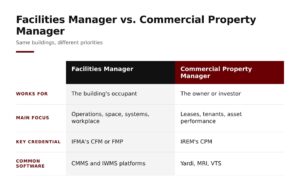
The skills overlap heavily, especially vendor management and budgeting, so moving between the two is common. Facilities experience is one of the recognized paths into property management, and property managers who prefer operations over leasing often move the other way.
Career Path
There is no single entry point into facilities management. Many come from skilled trades or building engineering, while others start in office administration, project coordination, or property management. A common progression looks like this:
- Facilities coordinator: handling work orders, vendor scheduling, and daily requests
- Facilities supervisor: leading maintenance staff or a single site
- Facilities manager: owning budgets, vendors, compliance, and strategy for a building or campus
- Senior manager or director: overseeing multiple sites or a regional portfolio
- VP of facilities or real estate: setting workplace and real estate strategy at the corporate level
According to the U.S. Bureau of Labor Statistics, facilities managers typically need a bachelor’s degree and related work experience, though some enter with a high school diploma and significant hands on experience. Degrees in facility management, engineering, business, or construction management are all common.
Skills and Certifications
Strong facility managers pair technical understanding with business judgment. They do not need to repair a chiller themselves, but they need to know enough to evaluate a contractor’s recommendation and weigh it against the budget. Skills that separate candidates include capital planning, vendor negotiation, project management, energy management, and clear communication with executives and maintenance teams.
Certification is not required, but the BLS notes it may give candidates an advantage. The International Facility Management Association (IFMA) offers the most recognized credentials: the Facility Management Professional (FMP) for earlier career professionals, the Sustainability Facility Professional (SFP) for those focused on efficiency, and the Certified Facility Manager (CFM) for experienced practitioners. In particular, a facilities manager certification is especially useful for anyone moving in from a trade or administrative background.
Pay and Earning Potential
According to the BLS, the median annual wage for facilities managers was $106,660 as of May 2025. That is notably higher than the BLS median for property, real estate, and community association managers. This is largely because facilities roles often carry responsibility for large operating budgets, critical systems, and regulatory compliance.
Several factors influence a facilities manager salary:
- Industry: healthcare, energy, and corporate headquarters often pay more because of the operational stakes
- Scope: square footage, number of sites, and budget responsibility
- Credentials: a CFM or engineering background strengthens negotiating position
- Market: Houston and Dallas have deep corporate, healthcare, and industrial bases, which supports steady demand
The BLS projects employment of administrative services and facilities managers to grow 5 percent from 2025 to 2035, with about 36,100 openings each year across the broader occupation. Hybrid work and energy costs are also reshaping the job, so managers who can speak to space strategy and sustainability are increasingly valued.
Is Facilities the Right Move?
If you enjoy systems, projects, and supporting the people who use a space every day, facilities management offers a clear ladder from coordinator to director. However, if you are more drawn to leases, tenants, and investment performance, property management may be the better fit, and many professionals build experience in both before choosing.
If you are exploring facilities or building operations roles, you can browse our latest openings or submit your resume to connect with opportunities.
 Founded in 1998, Professional Alternatives is an award-winning recruiting and staffing agency that leverage technology and experience to deliver top talent. Our team of experienced staffing agency experts is here to serve as your hiring partner. Contact us today to get started!
We're proud to serve the following locations:
Houston / Spring / Katy / The Woodlands / Humble / League City / Sugar Land / Irving / Dallas / Richardson / Lewisville / Plano / Arlington / Austin / San Antonio / Waco / El Paso / Fort Worth / Chicago / Seattle / Los Angeles / San Francisco / Tampa / Charlotte / Nashville / Washington DC / Boston / Philadelphia / New Orleans / Oklahoma City
Recent News & Insights

Facilities Manager: Career Path and Pay
When a company opens a new headquarters, a hospital adds a wing, or employees return to the office…

How to Become a CPA in Texas: Steps and Timeline
The CPA license is one of the most reliable ways to move up in accounting, but the path…

Houston Legal Staffing Trends 2026
Houston’s legal market has changed quickly over the past two years. Elite national firms are opening offices downtown,…