





The Hiring Pulse
August Edition, 2026
Make data-driven hiring decisions with confidence.

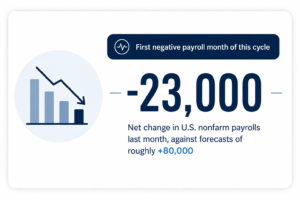
The national labor market shifted from slowing to shrinking. Payrolls fell for the first time this cycle, and the two months before were revised down as well. Texas moved in the opposite direction, setting a new employment record. The gap between the national picture and the Texas market is now the central story for hiring decisions this quarter.
U.S. Overview
- Employment Levels & Unemployment: The U.S. lost 23,000 jobs last month, against expectations for a gain of roughly 80,000. The two months before were revised down by a combined 103,000, so the earlier slowdown was larger than it first appeared. The unemployment rate fell to 4.1 percent, but mainly because fewer people were looking for work, not because more people found jobs. Health care continued to add positions, while education, retail, and financial roles lost ground, and the number of people on temporary layoff rose by 153,000.
- Job Openings & Layoffs: Job openings fell to 7.36 million, down from 7.59 million the month before, a sign of softening demand ahead of the payroll decline. Announced layoffs remain moderate: Challenger, Gray & Christmas reported just under 46,000 last month, below last year's pace, though this measure tends to lag other indicators. Initial jobless claims rose to 197,000 in the most recent week, up from a 57 year low the week before. It's too early to say whether that's a one week move or the start of a trend.
- Consumer Sentiment: Sentiment sent mixed signals. The Conference Board's index slipped slightly, while the University of Michigan's index rose for a second straight month. Wage growth also cooled, with average hourly earnings up just 3.2 percent over the past year, the slowest pace since 2021.
- Sector & Trend Signals: Taken together, this reads as more than a pause. Job openings, temporary layoffs, and headline payrolls are now all pointing the same direction, where a few months ago they were mixed. Temp help hiring had ticked up the cycle before, a signal that looked encouraging at the time but hasn't held up. There is no sign yet of broad layoffs, but the margin between selective hiring and a genuine slowdown has narrowed.
Texas Snapshot
- Overall Employment Trends: Texas added 43,400 jobs last month, bringing total employment to a record 14.47 million, the highest in state history. Texas led every state in both monthly and annual job growth. Over the past year, the state added 177,900 jobs, a 1.2 percent growth rate that outpaced the national average.
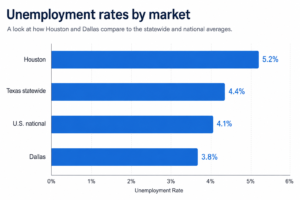
- Unemployment Rates: The statewide unemployment rate rose slightly to 4.4 percent, largely reflecting more people entering the labor force rather than job losses. Conditions vary by metro: Midland recorded the lowest rate in the state at 3.6 percent, followed by San Angelo and Abilene.
- Sector Observations & Policy Headwinds: Professional and business services led the state's gains with 25,500 jobs, followed by leisure and hospitality and trade and transportation. The Dallas Fed raised its 2026 forecast to 2.0 percent growth, citing the state's data center construction boom, steady oil prices, and continued momentum in staffing. The Fed's business surveys support this: Texas manufacturers reported faster output and an improved outlook last month, while service sector firms held steady on revenue but noted slightly slower employment growth, a small signal worth monitoring even as the overall numbers remain strong.
Trends to Watch
- National conditions have shifted from caution to contraction. Negative payrolls, downward revisions to the two prior months, and rising temporary layoffs all appeared in the same report.
- Job openings moved first. Openings had already declined before the payroll number turned negative, reinforcing it as a useful early indicator.
- Texas remains an outlier. A record job total and the nation's top growth rate mean Texas employers are operating in a tighter market than the national data suggests, even as the state's service sector shows early signs of slower hiring.
- Professional and business services stays strong. It continues to grow in Texas even as the national report weakens, one of the more resilient categories in this month's data.
- Wage growth has slowed as well. Annual pay gains are at their weakest since 2021, giving employers less pressure to compete on pay even as hiring pulls back.
Looking Ahead
- Texas's next data release is the key test. It will show whether the state can continue to outperform a national market that just posted its first negative month.
- Expect possible revisions. May and June were both revised down substantially after initial release, so the current -23,000 figure may not be final.
- Watch for another Dallas Fed update. After raising its 2026 forecast once, a downward revision is now plausible given the national data.
- Factor Texas into compensation planning. Employers hiring in Texas should expect continued competition on pay, even as national commentary shifts from cautious to concerned.
Data Sources
- U.S. Bureau of Labor Statistics, Employment Situation, July 2026 (released August 7, 2026)
- U.S. Bureau of Labor Statistics, Job Openings and Labor Turnover Survey (JOLTS), June 2026 (released August 4, 2026)
- U.S. Department of Labor, Unemployment Insurance Weekly Claims Report, week ending July 25, 2026
- Challenger, Gray & Christmas, June 2026 Job Cut Report (released July 1, 2026)
- Texas Workforce Commission, June 2026 employment release (released July 17, 2026)
- Federal Reserve Bank of Dallas, Texas Employment Forecast, July 17, 2026
- Federal Reserve Bank of Dallas, Texas Manufacturing Outlook Survey and Texas Service Sector Outlook Survey, July 2026
- Staffing Industry Analysts, June 2026 US Jobs Report (temp help data)
- The Conference Board, Consumer Confidence Index, July 2026
- University of Michigan Surveys of Consumers, July 2026
Make data-driven hiring decisions with confidence.
Sign up below for access and stay tuned for monthly posts highlighting key takeaways.